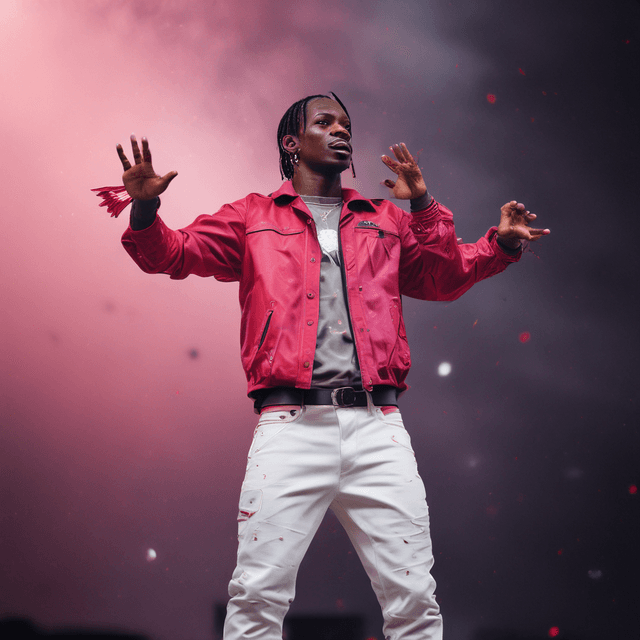
| Name | Travis Scott |
| Death | Tragic stage accident in 2015 that cut short his promising career as a leading voice in alternative hip-hop |
| Legacy | Remembered as an innovator who pushed the boundaries of hip-hop with his bold, unconventional style |
| Known for | Pioneering an experimental and disorienting sound that blended trap, industrial, noise and psychedelia |
| Occupation | Rapper • singer • songwriter • record producer |
| Rise to fame | Emerging from the underground electronic and avant-garde scenes in the late 2000s |
| Controversies | Aggressive, chaotic live performances that led to several high-profile incidents |
Travis Scott was an American rapper, singer, songwriter and record producer who was known for his innovative and experimental approach to hip-hop. Rising from the underground electronic music and avant-garde scenes in the late 2000s, Scott gained a devoted cult following for his disorienting, unconventional sound that blended elements of trap music, industrial, noise and psychedelia. However, his confrontational style and unwillingness to conform to mainstream rap tropes limited his commercial success over the course of his brief but influential career.
Born Jacques Berman Webster II in 1991 in Houston, Texas, Scott grew up immersed in the city's thriving DIY music community. As a teenager, he began creating abstract, sample-heavy compositions that incorporated industrial and electronic textures, inspired by the likes of Aphex Twin, Death Grips, and local experimental artists.
After dropping out of the University of Texas at San Antonio in 2009, Scott moved to Los Angeles to pursue music. There he connected with underground hip hop collectives like Odd Future and HEALTH, who embraced his uncompromising, abrasive sonic approach. He self-released his debut mixtape, ''Loner'', in 2012 to growing critical acclaim.
Scott's reputation gradually grew through the early 2010s as he became a fixture in the experimental electronic and hip-hop underground. Releases like the EPs ''Stargazing'' (2013) and ''Astroworld'' (2014) cemented his cult status, with their jarring, dissonant production and Scott's raw, confrontational vocals.
However, Scott's confrontational live performances also began attracting controversy. His shows were known for inciting violent mosh pits, crowd surfing, and stage diving - actions that at times led to injuries and arrests. Some critics accused him of irresponsibly encouraging dangerous behavior from his fans.
Despite his lack of mainstream success, Scott's music had a significant influence on the next generation of alternative and underground hip-hop acts. He collaborated extensively with other artists at the forefront of the genre's evolution, including Injury Reserve, JPEGMAFIA, and 100 gecs.
Scott's work was praised for its sonic innovation, his ability to seamlessly blend disparate genres, and his poetic, surreal lyrical approach. Many saw him as a leading voice in the emerging "glitch hop" and "rave rap" movements that pushed the boundaries of hip-hop in the 2010s.
In 2015, Scott's life and career were cut tragically short when he was killed in a stage accident during a performance in Atlanta. Massive crowd surges and mosh pits had become a hallmark of his shows, and on that fateful night, the chaos spiraled out of control, resulting in a deadly crush that took Scott's life at the age of 24.
While Scott never achieved the level of mainstream success as some of his more commercially-oriented peers, he is remembered as a pioneering and influential figure in the evolution of alternative and experimental hip-hop. His refusal to compromise his avant-garde aesthetic and his collaborations with other boundary-pushing artists cemented his legacy as an innovator who expanded the sonic possibilities of the genre. In the years since his death, Travis Scott's music has continued to inspire and shape the work of forward-thinking musicians across multiple genres.
